Showing posts with label D. Factual Programming. Show all posts

Thursday, 14 May 2015

The Nature and Purpose of Research

The Nature and Purpose and Research

Primary Research/ Self-generated Research 

This is is the type of research you conduct yourself, in a sense directive research, examples include interviews, questionaires, surveys. I researched around the college for participants to interview for our documentary on young people and their apathy to politics. I had an advantage while collecting induviduals for our interviews because I study AS politics, therefore other students in my class were effectivly significant for the role of being interviewed. Additionally I was able to interview my actual politics teacher for an experienced look on the subject. Another example of primary research I engaged in was a survey to ask other if they would be interested participating in the documentary and also questioning them on their interest in politics, so that we were able to pick and chose a range of people that were interested in politics and those that were not. Primary research is key in the media industry, being a researcher is an actual job role, for example if you were planning to make a rom-com (romantic comedy) then you might want to research when the best time to release this film might be, due to the reviews and when the most cinema tickets are sold for a rom-com and what time of year that might be. You could achieve this by creating your own questionnaire and promoting it on twitter and tag local cinemas or local film clubs and get their views, collecting data through effective networks.
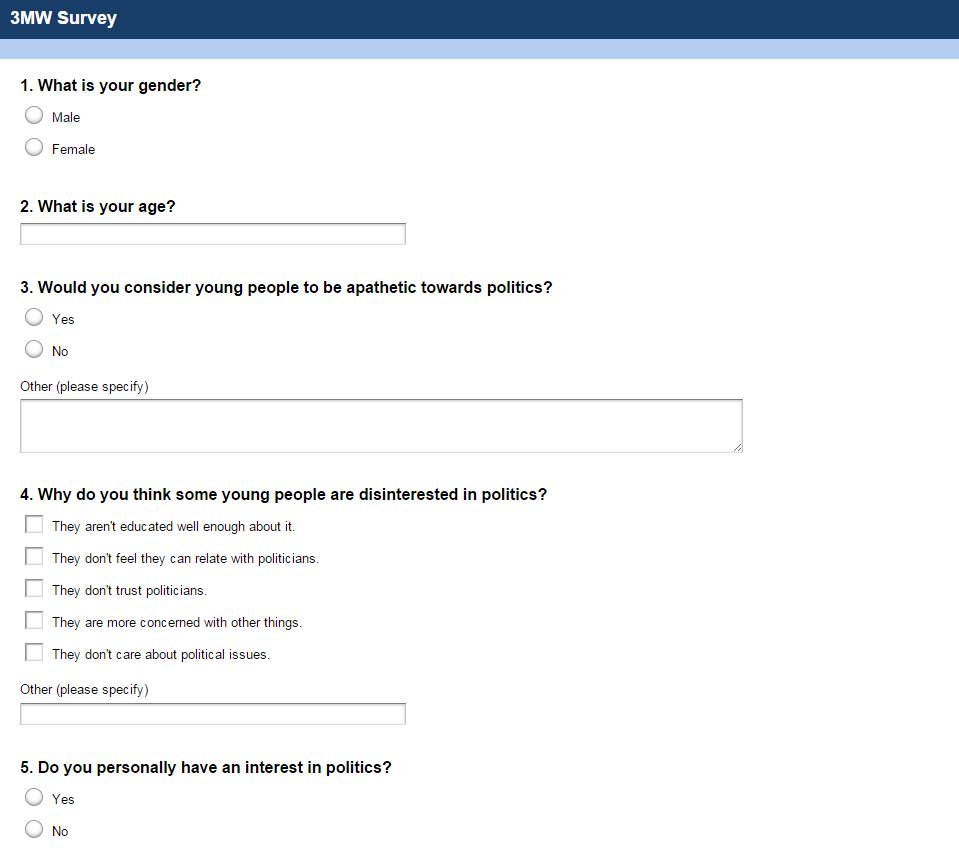
Here is an example of the questions in my survey.


Secondary Research 

This type of research is where another induvidual has already produced the research for you to extract the information, arguably an indirect form of research, examples include reference-based books, journals, the internet, databases, material ratings and especially government statistics in our case of our documentary based around politics. I produced a research post gathering our information that we had collected into one document to explain where we got our information from and how we were to use it. For example I used a youtube clip that was based around a similar idea of how we wanted to present our documentary, by interviewing a range of different people and asking them firstly factual questions about politics and then diving into if they were interested in politics or not and why. I also looked into what political parties do for the younger generation I did this by researching onto their actual sites via the internet, I looked into the database of the Labour party and the section aimed at young people and that is where I found the information.
 I also looked into government statistics to grasp hard evidence that would back up an argument within the documentary, also using the web to look onto public body websites referencing government evidence of young peoples interest in politics. Secondary research proves effective in the media industry because when you are given a task you may have to look up on the internet and research how to complete the task or something that could help you with the tasks, even using books from a library, however in the media industry it is usually the internet that proves most useful.

(link for figure 5 -https://www.youtube.com/watch?v=9Ic4JkAx5pc)

Research on policies from Labour

Quantitative Research 

This type of research is a data-led one, where it is includes opinions from what people think from a numerical/ statistical point of view, examples like programme reviews, hits on a website or sales on DVD's and CD's. The type of quantitative research I took part in was an opinion poll showing at the age where people are most interested in politics, I used this to reinforce the idea that young people are not interested in politics and that older people are more involved. Here are examples from my documentary. This is an important way to research if you are looking for facts and figures and in the media industry this can be effective when you are calculating ratings of films or viewing figures. Usually presented best in a table or a chart to show calculations in a simplified form to then present your findings, and also evaluating that research to see what the statistics show. 


Qualitative Research

This type of research is where the opinions of people is more in-depth and not so statistical, more about the individual feedback then the broad opinion. Examples include Film reviews, Game reviews, attitudes to media products, responses to advertising campaigns and responses to news coverage. An example from my research could be the questionnaire I conducted because part of that lets the answer be written in a text box if they wanted to give a more detailed reply. This is important to be used in the media industry because this is useful for companies who need to access the information easily and quickly, this works out well for the film industries when they ask people coming out of the cinema weather they thought the film was any good.

Survey Monkey


Additionally the interviews I conducted for my documentary could be classed as Qualitative research as the answer was a persons opinion in depth and detailed, even though it was after my documentary was made, an interview would be a successful way to collect research and information for a media production you are making.


Data Gathering Agencies 

B.A.R.B is an example of a broadcasting agency, it is the organisation that works with TV ratings and audience measurements, researching and giving information to the public domain to show what's popular and what's not and to show reviews of what people like when watching a broadcast.

http://www.barb.co.uk/ - example of what kind of figures are shown for TV ratings.


Another data gathering agency is IMDB, it is a large collection of entertainment information, including predominantly movies and TV programmes and who creates them. In depth detail into how and where the films are made and why they are made, including who stars in them all the way down to who produces the audio and lighting. IMDB started by a group of movie fans that indulged themselves into the findings behind movies and the deep detail into them. in a sense a site 'created by movie fans, for movie fans' - Quoted from - IMDB


Front page of the website, advertising new movie trailers.


An Additional data gathering agency is Box Office Mojo. 'Box Office Mojo is an online movie publication and box office reporting service. our purpose is to illuminate the movies through the integration of art and business. Based in Burbank, California, we produce news, analysis and the most comprehensive box office tracking available online' They also have an interesting copyright policy, you are welcome to use less than 20 names/titles of filmography on non commercial websites, magazines and information boards as long as your referenced the source you got the information from.
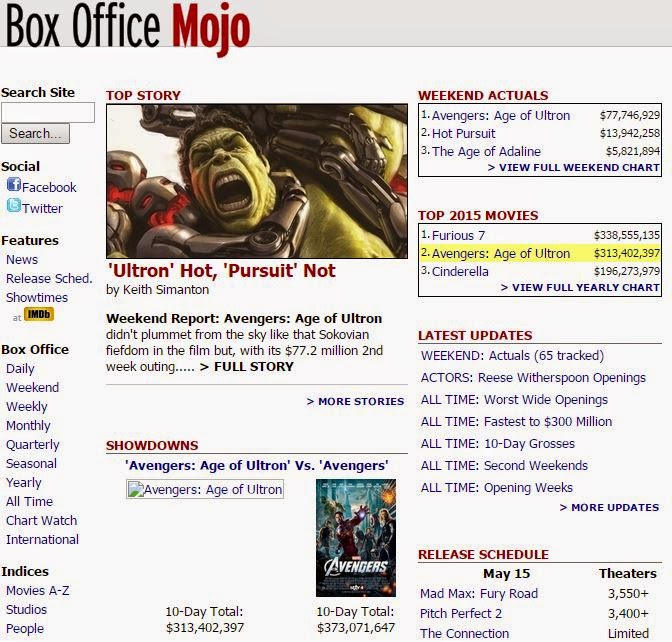
http://www.boxofficemojo.com/


Purpose of Research

Audience and Market Research:
There are many ways to conduct audience and market research in order to know how to target your media product and who to target it to, here are a few examples of ways you can research. Geo-demographics is how opinions and views can be different based on where the individual lives, for example a 19 year old boy living in Norfolk will have different views and opinions from a 19 year old boy who lives in London. Demographics is more about the different views and opinions of those in different social classes.


Here is an example of Geo-demographics in relation to violence profiles in certain areas.


Here is an example of a demographic chart, you can target specific areas of social classes, for example you could aim a job advert for specifically skilled manual workers and therefore post in an area where C2 working class would see it. 


An example of audience and market research I conducted was through the questionnaire on survey monkey,  asking first if the responded is a male/ female, to see if the results show that there is a difference in interests between sexes, as politics is known from the past and arguably the current that it is predominantly males that have a interest and take part in politics. Additionally there is a question on age as it is argued that older people are more interested in politics and this is where the idea for a documentary comes about.


Here is the feedback from question 1 on gender 
From the results we can see it is predominantly males that had an interest in taking part in the survey seeing as it was about politics, this is how we received our market research and incorporated this into our documentary by interviewing equally males and females. 


Here is the feedback from the age on question 2.
The age responses is what I predicted as I wanted to target the young audience and see if they are responsive to the survey and as we can see from the results, we can see that it was that age range that was interested in taking part. This is why we interviewed people of this age range to make it compatible with the results we gained from this survey.


Here is the feedback for question 5.
Here we can conclude the first two questions effected this question about interest, showing it was mainly males who took part in the survey and seeing that most of the respondents do have an interest in politics, therefore could argue it is mostly males who are interested. Also we can see that the idea of our documentary about young peoples apathy to politics is that there is an interest there, this was effective because we had to incorporate this into the interview questions we asked and how we produced our documentary.


Production Research

This section will include the pre-production paperwork that we had to research in order to set up and film the documentary. Personnel included me and my documentary partner going round our college and asking students if they would like to take part, however the responses were not as successful as we had hoped for, therefore we asked those in our class if they would be interested in being interviewed about politics and we had more of a positive response. Additionally I study politics which means it was easier for me to get hold of a few politics students and also my politics teacher to comment on the subject as he teaches young people on politics and has an understanding of the attitudes towards it as a subject. Next we had to plan shots, as mostly all of our documentary was based on interviews there was a lot of opportunity for free cam and unplanned shots, however we thought it would add structure if we did plan some potential shots that we could use. When the interviewing was taking place it was a shot of just the respondent, it did not include me asking the questions as I had an idea how I wanted to edit in a montage way, where the question is a title on the footage so the audience understands how they are reacting and to what question. This includes the storyboards and planning scripts as at the beginning I wanted to introduce what the documentary is about and inform the audience of what will be covered. Another task I had to do was produce a location release to have the permission to film onsite of college, and also to asses where we were filming to make sure there was no major risks and to analyse if the space was suitable to camera use. Lastly the production scheduled was the last piece of pre- production work we had to do, however we had to redo this as we didn't know exactly when we would start filming and when we would finish until we received the feedback from the interviews, after we received the interview papers back we could then plan the production and how long it will take.


Example of the personnel sheets

This is the recce evaluation that I conducted before we knew the exact locations we were using, I assessed the space that we could have used and the one of the college front we did end up actually using in the documentary. 


Production Schedule  
This is our 3MW documentary that we produced.

Friday, 17 April 2015

Research Into 'Youth Politics' Documentary

Research into 'Youth Politics' Documentary 


Participation has always been a struggle when it comes to politics, mostly due to the distrust the public have with the politicians, for example in the General Election 2001 only 59% of the eligible electorate voted. However the turnout is rising with 61% in 2005 and 65% in 2010, (1) our documentary wants to investigate the younger generations apathy towards politics as they are noted to be the least interested in politics with the lowest turnout in that age category. In the 2010 General Election only 44% of young people which has decreased from what used to be 66% in 1987,(2) we are looking at why this is the case and how young people could become more engaged within politics, looking at all the factors, is it the distrust in politicians? or is it that politicians do not represent that age category? therefore causes the disinterest. 

Here is what we are basing our documentary on, looking and finding out just how much young people know about politics and therefore to know if they are involved or not and why.


In the 2013 local elections, an estimated 32% of 18-24 year olds voted, compared to the 72% of those aged over 65.(3) This shows there is a crisis in young people voting and questions, should they be more involved as it is their future at steak as well as the other age category's. Additionally according to IPPR's statistics show that young people have been hit the hardest with public spending cuts, with 16-24 year olds facing service cuts up worth 28% of their annual household income.(3)

Labour Policies for Young People.(4)


Here we see political parties are trying to engage young people by situating policies directly for them, trying to include the young generation in politics could solve the participation crisis. However it depends if the issue with politicians is trust then it will be harder to win over their vote and their participation.


Chart to show the percentage of young people not in education and therefore politics could effect them greater if they are in what some may argue as the 'Real World'. (5)


(6) 
Above shows the most popular reasons why young peoples votes were lacking in the 2001 General Election, as we've noted the voter turnout has raised since 2001. However turnout in that age category is still significantly low, these are reasons that we will include in our documentary and incorporate these into our interview questions.


(7)
As you can see the 16-24 category above 40% have no interest in politics, I believe this is something to investigate because there is clearly a crucial reason why young people aren't engaged and aren't feeling politics is something that includes them. Even though I believe that the interest is rising possibly due to social media, as political parties and leaders are taking to social media sites like Twitter and Facebook to gain that audience's attention which is mostly aimed at the age group of 16-24 year olds.

(8)

(9)


Here we see examples of political propaganda and an example of how they are targeting young people by speaking directly to them, making them feel involved and gathering information from twitter a social media website instead of a news report. In our documentary we will investigate if this has made a bigger impact on young people being involved in politics by the political parties aiming and going through social media to engage them within politics.


We also took part in primary research by creating a survey on Survey Monkey, we wanted to find out about the subject before we produced a documentary about it(10)


(10)


This survey gave us a basis for what questions to ask our interviewees and what the audience would be interested in, in seeing, it could also get young people involved in politics by just watching our documentary, young people could find out ways to get involved and be a part of politics in society. We want to show that politics affects everyone and especially if you are student, and find out what the main attitude to politics is and why and this survey aided us in finding out own information to include in our documentary.


(1) - https://www.psa.ac.uk/sites/default/files/PSA%20Beyond%20the%20YCC%20FINAL_0.pdf 
(2)-http://www.exeter.ac.uk/media/universityofexeter/research/microsites/epop/papers/Henn_and_Foard_-_Young_People,_Political_Participation_and_Trust_in_Britain.pdf 
(3) - http://www.bbc.co.uk/news/uk-23832607 
(4) - http://www.labour.org.uk/
(5) - https://www.youtube.com/watch?v=9Ic4JkAx5pc
(6) - http://www.electoralcommission.org.uk/__data/assets/electoral_commission_pdf_file/0019/16093/youngpplvoting_6597-6188__E__N__S__W__.pdf 
(7) - http://www.bbc.co.uk/news/uk-politics-26271935 
(8)- https://twitter.com/Conservatives 
(9)- https://twitter.com/Ed_Miliband 
(10)- https://www.surveymonkey.com/r/?sm=vPEIWYwNInXzWjZKHTkWSg%3d%3d

Tuesday, 17 March 2015

3 Minute Wonder Research

3 Minute Wonder


A 3 minute wonder is a chance for directors that haven't yet had the opportunity to make and produce a film, 3 minute wonder gives them the chance to have that opportunity and create a 3 minute documentary on one specific subject. Channel 4 offers £4000 and their assistance in making their films which are then aired at 7:55pm every week day. The subject being documented is usually an issue not in the public eye and therefore is up to them to expose the issue. The topics range from poverty, illness to graffiti arts and food, they are completely a random mix of topics that are unreported on in the public media.


1 - 3 Minute Wonder Chloe Scotney, this documentary looks at relationships, posing questions, for example how the interviewees first met their other halves and why their relationships are so special.
What I like about this documentary is that it takes into account the relationship of all ages, younger 20's and to the older people who have been married for 20 or more years. It gives an insight to many different reasons why people are in love and also talks of how people found each other and that they are all different in their own way. Watching this I have learnt that there are many ways you can love a person and each person loves someone in their own way and maybe you don't agree with your friends decision, or they don't agree with yours to be with a particular person, however it is your decision and your happiness on the cards. Also learnt to take chances at meeting someone new because they could be the one you spend a long time with. This would be classed as a observational documentary because the filmmaker/director is not present and completely leaves the judgement clear to the audience for them to make their own opinion, they position a part of life without any interference of an opinion. 


2 - 3 Minute Wonder, If not school then what?, this documentary is about secondary school children who are excluded or do not fit into the school system, and what the alternatives for them are. What I like about this documentary is that it presents a topic that isn't necessarily shown to the public, a topic of children being excluded and going no where is reported about however not what possibilities there are for children who just cannot get on and work within the school system. This shows a group of people who care for the young society that aren't as capable as others but are willing to teach them skills that they would be able to learn at school but are more disadvantaged. I've learned what options there can be for people who don't fit into the education system and that there are jobs available to help these young people who suffer with this. This documentary format I would say is also observational as the filmmaker is not present and the documentary is ran by the people involved and the audience can make their own assumptions about the characters involved and what they think about the documentary without an opinion being forced at them.


3 - 3 Minute Wonder, The wall (pure evil), this documentary is presenting street artists and different graffiti techniques, it takes an insight into why artists do graffiti and what effect it has on the public. I liked this documentary because the authenticity was strong in the sense there was no voice over informing on what is happening and it felt as if it wasn't constructed because the filmmaker was not present and forcing an opinion onto the audience, it flowed and felt that the filmmaker was genuinely interested in street arts which therefore engaged me in the subject further. I learnt that sometimes graffiti art is no just vandalism but is a form of expression and some people devote their lives to such activities and that is their job, it also can improve the look of an area with the type of art presented. Included what I have said this is also an observational documentary which I believe is the strongest documentary type because there is no narrow view point on the issue and the audience can make their own minds up about the subject.


Market Research into Documentary format and current viability.


For the first part of my research i have decided to look whats on, on a weekday because the type of documentary may differ from what could be shown on a weekend. I chose the times from 7pm because that is when people will be home from work and sitting down for tea and possibly watching the TV and these are the documentaries available. Here we can see there is a documentary called 'The Benefits Estate' that is about the money crisis of people who do not have jobs and live dependently on benefits, another documentary 'Back in Time for Dinner' this is about the UK food from the 1950's up until now with a family trying out the foods and living on them for six weeks. Both of these documentaries have in common the fact the audience can relate to money crisis's and have opinions on food, a documentary the audience would understand and relate to would engage them further, additionally placing it on a weekday when people have been at work all day this is the type of thoughts that are in the mind of the public and therefore the documentaries compliment their thoughts.


This is a TV listing for the weekend and we see here there is less documentaries being shown, possibly a reason for this is because there are other shows that get more views that involve more entertainment and celebrity content and are only available on weekends. The factual programs and documentaries shown still apply to that relation to the public's lives for example GP's Behind Closed Doors would be of high interest in the public because it involves them, as the majority of the public have a GP. At prime time on the weekend was the honoring of Afghanistan soldiers service which would have been in high public interest within the whole of the nation, this could be said that the more high profile and more in the interest of the public then the closer to peak time it will be on. 


From the BARB website this is the percentage of popularity in the documentaries and other entertainment programs. As you can see 11.9% coming in third of the most popular types of program, this is where documentaries lie. Surprising it is above the news and just shows how maybe the pubic seem to believe documentaries more than the news, however this is only a possibility. Could be seen the other way round as drama which is fake is more popular than documentaries, this means that the public could possible prefer a fake and fantasy instead of the truth and reality. As we have seen the documentaries that tend to be on at prime time are ones in the public interest and most relation towards the subject.


Here we see a popular documentary which was about a prison, looking at this it reinforces the idea of what could be in the public interest and prison is a controversial topic of the nation, which could be a result of the successful 6.35 million viewers last year. Showing that factual programming is actually becoming more popular and people are being to spike an interest is more of the truth, according to this quote, specifically to the channel ITV seems to be the most popular channel that withholds these documentaries.   


Tuesday, 10 March 2015

Documentary 'mini task'

Documentary ‘mini task’
Documentary is a widespread term that comes in various different forms in television and film, all of that include an element of presentation and reality. They document information on a certain subject chosen and deliver that to the audience in different forms. The different forms are used to show the subject in a different light, these types can strengthen the authenticity or weaken it.


Expository Documentary
Incorporates a voiceover which directly addresses the audience on what is happening in the documentary, to give a narrative to the images and not an opinion. Truths and influences are given by the voiceover which some may argue is forcing some sort of opinion onto the audience on how to think of the accompanying images, which therefore could distract from the authenticity. Images that are informative and descriptive are used to aid the voiceover, the main effect of an expository documentary is that is gives a direct and clear representation of the subject presented. This can be shown for example in ‘Wild China BCC Documentary’ - https://www.youtube.com/watch?v=MtQqQtcqA2o&list=PLFC0617F4B1D65266 The voiceover is giving facts about the Panda in this sequence, of the specific diet while there is an image on the screen of the Panda eating, this is where the image aids the voiceover by backing up the point the voiceover has given. The voiceover informing the audience that the Panda has sensitive hearing and that it will be gone before anyone can see it and there again the moving image is the Panda hearing a noise and being on the move, the images complimenting the voiceover. ‘1 meter and a half long and 135 kilograms the Panda is part of the bear family’ This is a quote to show the voiceover giving descriptive and clear information of the subject. A phrase the voiceover uses ‘it’s body is built for eating meat not this tough fibre stuff’ this is where it can be seen to distract from the authenticity and form an opinion over the audience, however also is evident of an expository documentary because it captions the images presented. This type of documentary I find to be more realistic due to the facts told by the narrative and the accurate footage of the subject that mainly consists of cuts, therefore cuts tend to make it seem less edited and more realistic. 


Observational Documentary
In an observational documentary the director/filmmaker is not visible from the audience’s perspective; they present a partition of life from an uninvolved point of view. The opinion of the director/filmmaker is more unnoticed and therefore could be argued as more realistic as it doesn’t expose an opinion on the audience. Observational documentaries present a clear view of events which is non-judgemental, therefore gives the audience a choice to decide what to think from the text and more of an intimate and exposed look on the topic. This is evident in the documentary called ‘Rough Aunties’ - https://www.youtube.com/watch?v=jCvqt1XDB9U This includes no input of the filmmakers/directors it is as if the subject is being filmed without instructions and this strengthens the authenticity as it seems not as constructed. It observes the life style of these women who work to protect and care for the abused, neglected and forgotten children of Durban, South Africa. Even though there is no involvement of the producers there is text at the start that informs the audience of what is happening, however that is only shown at the start. Furthermore through the documentary there is no visible involvement of the director/filmmaker which gives the audience an opportunity to interpret how this documentary makes them think/feel towards the subject. I believe this to be one of the most realistic formats of a documentary due to the observational side of recording, less constructed shots and also no narrative point of view, it is up to the audience to decide what to think of this. It also shows accurate footage, as it is seen to be unplanned shots, we could perhaps assume the directors are unaware of what they will be finding out, therefore unaware of what shots to include.

Here you see the text on the screen informing the audience
of facts, instead of the director/filmmaker being present.


Interactive Documentary
The filmmaker is present and they are participating in the documentary, there is an interaction between the presenter and the people they are interviewing also including the audience. Agendas are current and the text is manipulated through the use of the editing, accusations that the text is misrepresented and not a legitimate assessment; however that is defended by the filmmakers because the actual image is more focused on than the fine detail of the subject. An example of where this is evident is in Ross Kemp’s Extreme World Documentaries, this documentary is about the poverty and black community in Memphis and what violence is consistent and why. https://www.youtube.com/watch?v=mRUGpQ04EdE.
This text shows the filmmaker is participating in the documentary by being in the shots and giving information and evidence on the subject, keeping it in concise and clear detail. The presenter has a key connection with the interviewer and then involves the audience by using phrases like ‘What some people may say is…’ making the interviewee include what the audiences opinion could be. However this could be seen as a type of manipulation because giving opinions of what the audience might think is then placing an opinion that forces the audience to think this. There is a large amount of footage showing the very bad and abandoned side but that seems to be the only side that is shown this could be said to misrepresent the subject, however could be defended that it was for the ‘image’ as the image is more focused on than the actual subject. This text also includes arguments on the subjects however the presenter takes a look at one side of the people on the streets and then takes the other side of the argument by meeting and interviewing the district attorney. This format is seen to come across less realistic due to the use of constructed shots and background sound, it also includes the narrative's opinion and that is delivered through the use of the presenter and their reactions are questionable, whether it be their actual reaction or what they have to react like. 

The filmmaker present and participating in the documentary

Possible manipulated agenda by only showing the negative
side of the story possible criticized as not legitimate

Planned camera shots shows how the subject is less focused on
and it's more about what the image and presentation looks like


Interaction between the presenter and the people, interviews
showing a slice of the truth from a more authentic perspective


Showing one side of the argument on the subject

Here showing the other side of the argument 

Involving the audience with the people being interviews and possibly
manipulating the audiences opinion and trying to make them
think a certain way about the subject.

Reflexive Documentary
In a reflexive documentary the director/filmmaker tries to expose the truths of the documentary to the audience, the documentary shows the constructions of the text and also the investigations of the text. The documentary will consist of various shots that capture ‘day to day life’ but they can be shown as ‘a’ truth and not ‘the’ truth, to form a certain viewpoint of the topic that can be presented to the audience. This is shown through Koyaanisqatsi – reverse, this documentary is about life and the balance we have and sometimes do not have - https://www.youtube.com/watch?v=_5Hr1C62Smk. This is a reflexive documentary because the text consists of shots that have captured day to day life. For example there are images of people going to work and actually working, which then cuts to something completely different therefore shows the text is constructed and experimented with to compliment the soundtrack. Some may argue that the music distracts from the authenticity and the planned shots could hide an element of truth. On the other hand the footage seems realistic because it’s different each time and there is truth in the images just not so much the way it is presented. However this also makes it unbiased with no opinion forced onto the audience, this could be seen as a positive because the audience can make up their own opinions on it, although negative because there is no backbone and lacks meaning. This type of format is arguably realistic by capturing day to day life without a narrative, the footage speaks for itself and therefore it is what the audience interprets that makes it more accurate. However the sound track is questionable because it could make the audience feel a certain way about the images on screen, due to what type of pace the music is on, overall I believe this is fairly accurate without delivering facts and figures. 
Filming everyday life to expose the honest truth, capturing
legitimate everyday life images.

This is another shot that shows everyday like but possibly 'a' truth
instead of 'the' truth


Performative Documentary
A performative documentary includes re-enactments and hyperbolic camera position, the music used is to make the audience feel a type of way, whether it is tense sound to build tension or upbeat sounds to invite happiness. It aims to present the subject in an expressive and suggestive way. It represents the world indirectly and has more focus on the presentation rather than content. An example of this is the documentary on Serial Killers - Myra Hindley & Ian Brady (The Moors Murderers) - https://www.youtube.com/watch?v=Q2n8mI2LOKA. In this documentary there is use of re-enactments to construct a visual understanding for the audience, this may be criticised because it could misrepresent real events and force the audience to have a certain look on the situation and sympathise for who the filmmaker wants you to sympathise for. In addition re-enactments are used to show the audience visually the events which took place and to give them a deeper understanding. The use of showing real pictures and evidence of the subject’s existence adds to the authenticity and makes the audience trust the documentary, additionally reinforces the idea that a performative documentary has more emphasis on presentation and the image on the screen than the actual content. Using the images also aims to present the subject in an expressive and emotive way. They interview an author of a book that took an insight into the subject and a screen writer of a film on the subject also spoke to people who knew the subjects and this increased the authenticity of the documentary because they are getting their information from somewhere legitimate. This type of format is arguably the least realistic due to the format name itself  'performative' sounds constructed and emphasised, however there is a realistic side to the documentary, these documentaries usually include reliable sources of information, for instance the example that was used earlier about the serial killers, they spoke to family members and old neighbors that could give them concrete evidence of what these people were like. However the use of re-enactments and a soundtrack potentially distracts from that reality, and makes it more of a entertainment programme and arguably more 'film like' than an accurate and believable documentary.

Using an image of the subject creates stronger authenticity

Focusing on the presenting of the subject by showing a certain
side of the subject to make the audience think/feel a certain
way about the subject.

Here is a re-enactment this is to make the audience have
a greater understanding of events that did truly take place.
However the re-enactment could warp the realistic
events and therefore weakens the authenticity.


The Conclusion 

To conclude, the format I find to be most effective in presenting an accurate and realistic documentary is an observational documentary, due to the fact that is observes the truth and presents it in a non opinionated light. The shots are not as constructed as other documentaries formats, the only constructed shots are interviews which still comes across as realistic due to the questions asked which don't seem to be planned either, due to the spontaneous language used with fillers and filled pauses. I believe all documentary film makers should be completely honest, otherwise it defeats the object of the documentation of the truth, however I do understand why performative and expository documents are proven to be popular, it is always more entertaining to add a soundtrack and stretch the truth to make it sound better, although it does sell successfully, I believe it distracts from the reality of documentary film making.


Monday, 9 March 2015

Introduction to The News

Part 1:News Stories.

A starting sequence is what the news begins with, like an introduction into what the news is about. It is what the audience first witnesses, which means it has to be eye catching and short to be remembered easier. Here are two examples on a starting sequence:


This is the national news introduction and various different versions of it. It is captivating the audience by the tension building and demanding music, could be described as a 'heart beat' sound because of the way the tone is set in a pattern. It makes the audience prepared for what is coming up in the news, it is also repetitive which means that it can be remembered and recognised by the public. The graphics are interesting because they seem to represent a sphere form which could represent the world which is why it has been used on the national news, additionally the graphics of different countries shows that this particular news, reports worldwide. The colour scheme is predominantly red and white, which is known as the main BBC colour scheme, they could use this in the starting sequence because it is recognisable to the public but also red is a striking colour and draws the attention of the audience. 


This is the opening sequence for the different English regions, we can see the difference through the sound, the music is not as sinister, but more exciting, which could suggest it is not as important, due to the fact it is not a national issue but a regional issue, resulting in only effecting the public in that particular area. The colour scheme is lighter, there is more white than red this reinforces the idea that there is a less demand for this news rather that the national news, therefore the introduction doesn't cause as much tension for the audience. 


After watching Sky News 9th of March 2015 the order of the stories were:
-Free schools opening up almost double under conservative government in next general election.
-Missing school girls found in turkey crossing the boarder into Syria to IS militants.
-Crufts dog poisoned from meat, other dogs have fallen ill since.
-First solar plane which is charged by the sun sets off for a worldwide travel.  
-Child diabetes is rising in recent years
-Toddler rescued from a car that had crashed 14 hours earlier, alive.

In the first main headline story is to do with the general election and a current government (conservative), the reason this is the 'lead story' is because it is relevant to the whole of the UK, the politics of the country affects the people which in a sense shows that the lead story is the lead story because of its rev to the public and whats in the public interest. The second story has some relevance to the public because it was English girls that have been radicalised and the news is trying to raise awareness about radicalisation to try and prevent it from happening. After this we slowly see how the relevance decreases in the public interest and the other stories have a main purpose to inform the public of what is happening around the world. Additionally with the main headline there is always the audio effects that has a sharp sound to emphasis the importance, also has the footage that compliments the story and gives the audience a visual understanding of the story. They finish the news agenda with a positive story of a toddler being found alive 14 hours after the car had crashed, this leaves the audience with a hopeful and positive feeling. (Read down for more information on news ordering).

Part 2:The Role of Presenters


The job of the presenter is a very arduous task, they have to prepare their own scripts and incorporate formality and personality while ordering the news stories. They often start with the main shocking story and then lighten it up as they go along, they link stories by merging each topic into the next, for example if they were on a topic about schools opening or school issues the next story might be about a family linking the school, to children, to a family issue. Their duty is to tell the story in an engaging way, using personality within their speaking and not just reading off of a script, they often use a deeper and stern voice when talking about high profile events and a lighter and different tone when talking about a lighthearted story. Usually there is a female and a male presenting the news, this could be to represent the two sex's and ruling out criticisms of being sexiest, the male is usually a mature age roughly 40-50 and the female possible 10 years younger 30-40 or late twenties. However this is changing in the present and younger male and females are taking on the roles of being a presenter, this could be because they are younger and possibly more outgoing/bubbly than others, or they are using convergence to connect to a younger audience. They have an ear piece in where the producer, director and floor manager give them instructions on what to say and where to look, some cameras change and they have to be told to look in the correct camera, they also have to be informed if the producer has suddenly taken a story out of it, or they here instant breaking news and have to report the information right away. They have people speaking to them in their ear while they are talking and delivering the stories for the audience and have to handle it calmly and know what they are doing, Multi-tasking seems to be a key skill in managing a presenter job. It's said that when there is a light backdrop they tend to make the presenters wear darker colours to stand out and look more formal, however when there is a dark backdrop they tend to wear lighter colours so it doesn't look dull and gloomy to the audience and create a negative effect. Overall the role of a presenter is a challenging one but also enjoyable because you can incorporate your personality and be on the ball knowing exactly whats happening in the world and translating that for the audience to comprehend.(3)


Here we have examples to show a presenter while reporting, the papers on the table are usually sub headings into what they need to remember to talk about as well as reading the information on computers. However some may argue it could also just be for show, to make them look as if they have a lot of news to present to the public.(3)

Presenters have to keep quite neutral to the stories they report they cannot show any emotion towards a subject and therefore must keep neutral and use a stern tone to stay professional.


Part 3:Ordering of the news.

The importance of ordering the news is crucial, you must be able to attract the audience with whats called a 'lead story' this is the story they have the most information on and therefore go into the most detail. The lead story is often the most shocking and most relevant to the public and in their best interests, usually national or possibly international if it affects them. In ordering the news there are round ups, for example all the local news might be presented by one presenter who rounds up all the local news in a certain area, national and international stories can also be 'rounded'. Sport is another popular subject that usually has a separate presenter where that subject gets rounded up. The main stories are always said at the beginning with a hyperbolic audio effects and usually visual images to attract and engage the audience in a story that is relevant to them. Other stories are often mentioned by the presenters without any visual effects or audio because they may be of not great importance or relevance to the public interest. The ability to think and act quick is important because the news is changing constantly and the presenters and the news need to keep up with whats happening in the world and report that as soon as it happens. The term 'slow news day' is when there nothing major that has happened with great importance or relevance to the public interest and therefore there is not a quick and busy day full of information, they tend to tell less important stories that some of the public may have an interest in, however some may not. Then there is the final news story of the broadcast, the term is the 'and Finally' story, the news usually delivers a lighthearted story mainly to entertain and to leave the audience with a positive story and a positive feeling rather than a deep and negative story leaving them with a down feeling. The duty of the news is to inform the audience of whats in the public interest and what can effect them, whether it be international or national or local.


http://www.bbc.co.uk/news


http://www.channel4.com/news/


http://www.itv.com/news/

The term 'news values' determine how much importance a news story is given by a media outlet, and the attention it is given by the audience. Galtung and Ruge (1) wrote about different types of news values, firstly frequency(1) which is the unfolding of an event has to correspond with the needs of the news media, the daily news tends to focus on events than longer trends. Secondly the threshold(1) which is the more bigger the event, the more shocking the story is, the more casualties/fatalities the bigger the story becomes and the more newsworthy it is because it grabs the audiences attention in shock. An example of this is the Japan earthquake/tsunami over 1,000 casualties made this one of the news's top stories in 2011. Thirdly the lack of ambiguity(1), the clearer the motive of the story the easier it is for the audience to understand, an example of this is Quantitative Easing it should be a huge covered story, however because it is harder to understand for the audience it is not high priority in the news, the news likes to spoon feed the audience more and gives them simple stories to comprehend. fourthly the meaningfulness(1) which is within the cultural environment there has to be significance or relevance behind it, linking it to the audiences interests, for example the honouring of the UK military service from withdrawing from Afghanistan, it has relevance to the country and the audience, it has meaning to the public. furthermore predictability(1) this gives an accurate foresight of stories featured in the news,for example the armistice day, poppy's laid in UK service Honor in WW1, this is predictability is because it is predictable that they will hold a massive event to Honor service to the military in WW1. this follows to unpredictability(1), unexpected events are newsworthy because they also shock the audience and out of no where makes it more hyperbolic, an example of this is 9/11, it was an unexpected terrorist attack which shocked the world and became the 'breaking news' taking over every news channel in the UK and the US. Next is continuing news(1), if something is already newsworthy it will be continued even if its importance decreases, an example of this is the royal baby, it was on going because it was royalty and royalty is seen as a high importance topic. Composition value(1) is a balance of sport news, celebrity news, international and domestic news is required it keeps the audience up to date with all the latest on whats happening within the world. Following on there is Elite nations and Elite people(1), with economic power or political power are more newsworthy because they are consider the top of importance, and what actions they take could effect the audience. News should be presentable in terms of the personal(1), this means now and again they should focus on the 'ordinary' person and therefore the audience can relate. Lastly negativity(1) in the news is considered popular and newsworthy because it is clear, concise and easy for the readers/viewers to understand, an example of this is the story on Ebola a disease that has taken 9,976 lives, one of the biggest epidemics seen in years.


Part 4:Broadcast about the Chowles.
The story was about mortgages prices that are rising and people cannot keep up with their mortgage repayments and the amount of people who's houses have been repossessed has double within a year. The Chowles have recently brought a 1 bedroom house for 57,000, however Mr. Chowles recently lost his job due to ill health and since then, they have fell incredibly behind on their mortgage payments. The broadcast shows the struggles the family have not only being behind on their bills but they also have another baby on the way and with only one parent working, their struggle will only get worse. The people involved in the broad cast are Mr and Mrs Chowles with their 1 year old child, they are represented in a way to make the audience empathise with them. We see this in the first piece of footage of Mr Chowles walking up to his recently brought house, he slips on the ice but regains his balance, this creates an effect to make the audience empathise because it shows he is vulnerable and makes him seem weak. In the next piece of footage it is Mr and Mrs Chowles playing with the baby and it's toys this shows they are a loving family that really cares about their child and that shows innocence which when they talk about how they are struggling it makes the audience feel bad. This could be a reason that, that particular piece of footage came before the couple spoke about their struggles to make the audience judge on what kind of people they are and then the next footage creates a feeling from the audience of empathy. The next piece of footage includes the Chowles sitting on the sofa with their baby in their arms talking about the struggles, Mr Chowles states that he wanted to 'finally do something responsible' and do something good for himself and ends up worse off than he could have imagined. This makes the audience empathise by him telling a story of how he wanted to improve himself and had high hopes and they came crashing down and now he and his family are in a terrible situation, it gives the characters in the broadcast and innocence which is why the audience feels sorry for them when they talk about their situation, in a sense the audience could feel they don't deserve this because they have been presented as nice and innocent people.

I personally did feel sorry for the couple and fell into the broadcasts plan to empathise with them and their difficult story, the fact that Mr and Mrs Chowles voices also had worry and innocence in them, made me feel sorry for them even more, and actually made me believe the story more because they genuinely seemed distraught. The news story was narrated at times when the Chowles weren't talking, for example when Mr Chowles slips and when they are playing with the baby and it's toys there is a narrative there talking about how difficult the struggle is and about them purchasing the house, giving the audience information but also giving them a visual effect that makes them empathise with the family. The narrative also helps the audience follow the events what happens, if the footage is shown on the screen without a narrative it would confuse the audience into why they are showing us this and what has happened, with the narrative it bases a story around it and involves the audience into these peoples lives.


Part 5:Broadcast I have chosen.

The story I have chosen is the Michael Brown Ferguson shooting, reporting that tension are high with riots and police are armed and heavy. The people involved in the story are the rioters with footage of them, the police forces with footage of them in action and the news station speaks to Thomas Jackson who is in the Ferguson police department, there was also footage of the lawyer of the Michael Brown's family making a statement that they want the name of the police officer that shot their son, and the news correspondent who is reporting from Ferguson, John Yang. Additionally there is a statement from the president Barack Obama. In the story they show an image of armed authorities aiming their guns to black man with his hands up, this creates a feeling to the audience to feel sorry for the people of the community, people who are standing up for their rights and being threatened for their freedom of speech. Then it shows the other side, the town itself has been vandalised by the rioters, this may change the opinion of the audience because they have destroyed a town for those who are not participating in the rioting and suggesting that the way they protest is violent and this is why the police forces are so heavily armed. Then you see the protesters again yelling at the police, could be taken to make the protesters look like they are in the wrong. However they back track in favour of the protesters saying how they walk with their hands in the air and are still threatened by the police, they also repeat how Michael Brown was 18 years of age, unarmed and was killed and shot more than once. Which makes the audience empathise with the family of Micheal Brown especially when they lawyer makes a statement with word stress that they want the name of the police officer who killed their son to be released, the audience can relate to this and puts them in a place that if that was their son what would they do. When they interview an officer from the police department he defends the shooter saying they will not release his name while he is receiving so many death threats, this could potentially make the audience be more understanding of the police situation. I personally feel sorry for the protesters to me it sends the message they are protesting and the reason they are being violent is because no-one is listening to their calling out, therefore they use violence to make people/police listen to them. The story is narrated to show the images complimenting the voice over, for example the voice over comments on shops that are reopening after the looting riots had taken place, while showing images of the shops getting ready to re-open, this helps the audience follow the story and keeps them up to date with an understanding of whats happening on the screen.


Part 6: Bias.
There is bias through selection by a pattern of news stories that coincide with the agenda of either the left or right, while ignoring stories with the opposite view.(2) An example of this is printing a story released by the conservatives or the green party and then ignoring the studies or stories on the same or similar topic from the Labour party (the opposing group). It creates a bias between the selection and that it is a possibility a news station has a certain agenda or opinion on the topic and that in a sense is forced on to the audience because they are only seeing one half of the story, what that particular reporter wants to you to know/see. also can be seen by how much airtime a certain party receives, if the Conservatives received more airtime to talk about their policies longer than the liberal democrats then the importance what the news station believes is more important to the public is shown, through how long or how much they talk about one specific subject.

Bias through omission by leaving one part of an article out or a series of articles out over a time scale, by leaving a certain part of the story out it shows only half a perspective or even a part of the story that actually is not how it happened.(2) An example of this is when Sky News chased after a woman called Brenda Leyland who had been a known 'twitter troll' and wrote abuse to the McCann family, when Sky News found her at her home she repeated that she was not answering any questions and had 'no comment', what they didn't show was that she offered an interview instead where she apologised to the McCann family. The result of sky news's omission, the public abused Brenda Leyland and a few days after the news release she was found in her hotel room, she had committed suicide. The results of omission are rarely extreme as this but this shows just how effective it can be, not showing the truth within a story. 

Bias within placement is a measure on how important the editor considers the story, placement of headlines is key because it is the most important part of a newspaper and the part that everyone reads before they purchase the newspaper is has to be the biggest story that is most relevant to the public interest.(2) An example of this is today's news:

This shows that what the news believes is of the highest importance of the British public interest is the final
budget decisions for this parliament, slowly followed by another political story of the new government in Israel
and then to obesity, followed by the northern lights being seen in Britain. However the headline
is the key mechanism to attract the people and the fact that it is placed on the front, directly addresses the audience and show the significant importance.


 Bias shown through the camera angles and shots used when covering a story can show a particular way that the news presents this story and how they look at it and in what way they present it to the public to think a certain way about it.(2) It places a narrative to the image the way it is presented via angle, arguably manipulating the way the audiences see the images on screen from how they would see it off screen.

This is an example of how they are showing employment, a low angle shot this shows the subject in the image as dominant and in this example the businesses are dominating over the public because unemployment has
grown to 1.86m. In this case the news may be trying to scare the public and worry them about this by using this image, it is oppressing the public making them vulnerable.
 
The camera angle used here and the labelling of 'Budget' could suggest that if effects everyone or will affect everyone's day to day life. By presenting it this way it creates fear for the public and therefore they want to learn more about this subject and what exactly is going to happen when the budget is announced.
 

Lastly bias through the naming and the captions is used to describe a person in a certain way that you want the audience to see them and possibly make a judgement on them just through what they do for a living and what the news has labelled them as.(2) For example the news may call someone a 'Terrorist' and some may call them 'Freedom Fighters' it all depends on the perspective and the motive behind the news stations and how they want to present a certain subject, how they name/label the subject is a crucial factor. Bias through the use of language and phrasing on a certain topic, can show an opinion on the subject by using emotive language on an issue, seeing the presenters opinion of right and wrong. Here are examples of both bias's:


An example here is 'AFGAN VIOLENCE' this is just what the news has labelled it has which shows an opinion/motive of what they believe is happening. Some news channels might call it the 'Afghan Revolution' it all depends on the perspective
of the news channel and what their perspective is and how they have been told to present it to the audiences


Here we see the news describing the London Riots, the phrase 'Skirmishes' is very elevated for the news to use and for the
public to understand, this could be used to emphasis how serious the riots were and how serious the situation is. Additionally
'youths' when the public hear the term 'youths' some may argue there is already bad thoughts about it, this is emphasising that and making out the youths to be anti-social and destructive, this is where we see the opinions and views of a news broadcast and how they present that to their viewers and pass on that opinion to make the audience think a certain way.


Politics is a big subject not only on the news but in society and the news channels play a big part is trying to not show a certain side of what party they support, however we can tell by the amount of air time a politician gets from a  certain party and also how the news channels talk about their policies and compare them to other party policies. For example here they are talking about the prime minister from the conservative party the use of the phrase 'Welfare shake-up' doesn't necessarily have positive connotations and therefore develop a view point the audience will carry and make the audience possibly
reconsider who they are voting for. Where as if they were speaking positively and called it 'Welfare Revolution' or 'Welfare changes' something neutral even, then it would not be placing an agenda on the audience members.    


The phrasing here of 'crisis' is in place possible to make the public fear and therefore they will be more interested in listening because they want to know more information of what's going on and to understand the fear they are being presented with. It is in place to make the audience feel a certain way it could be every time the euro comes up it is a 'crisis' and that could not necessarily be the case.


Sources